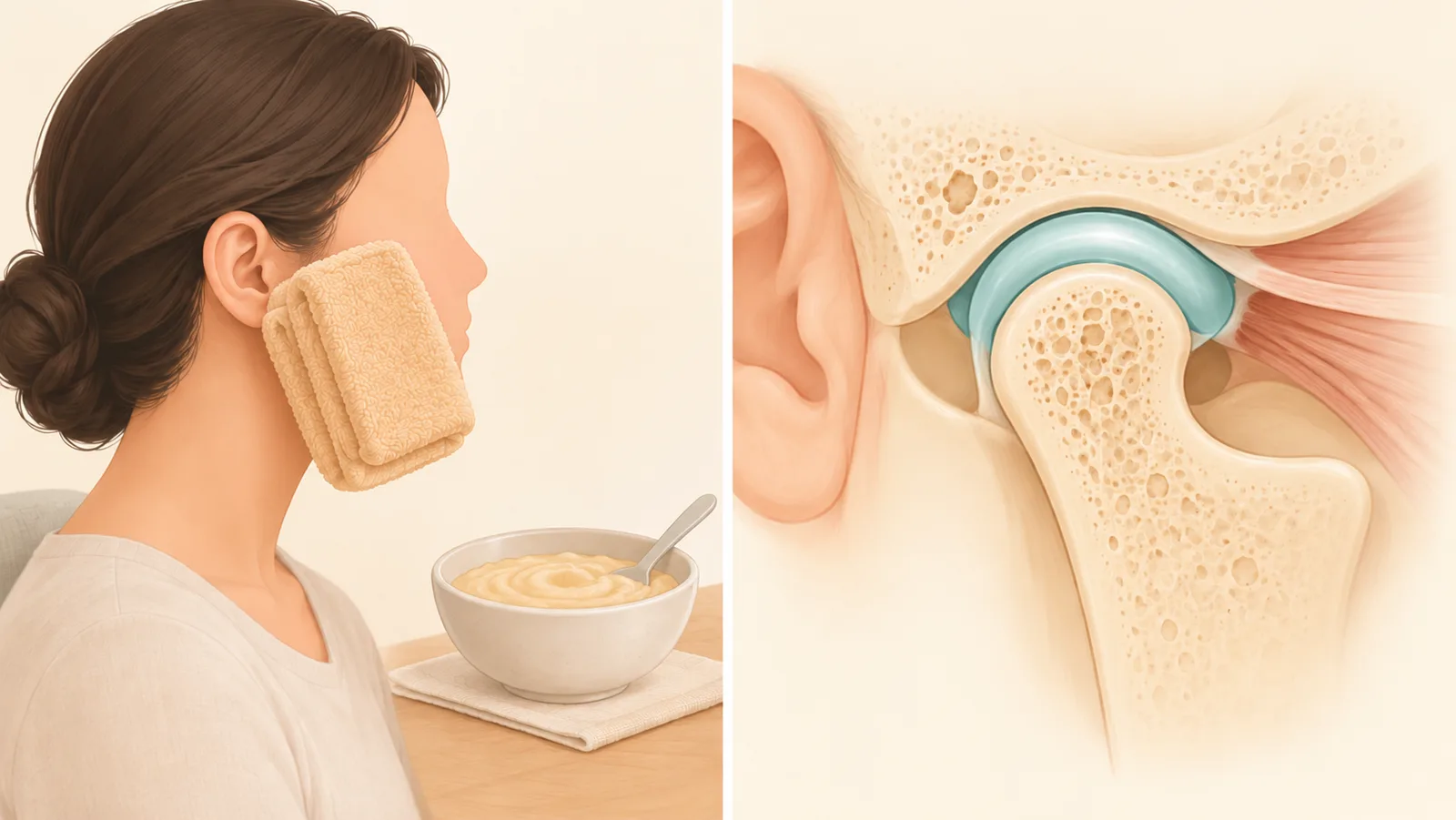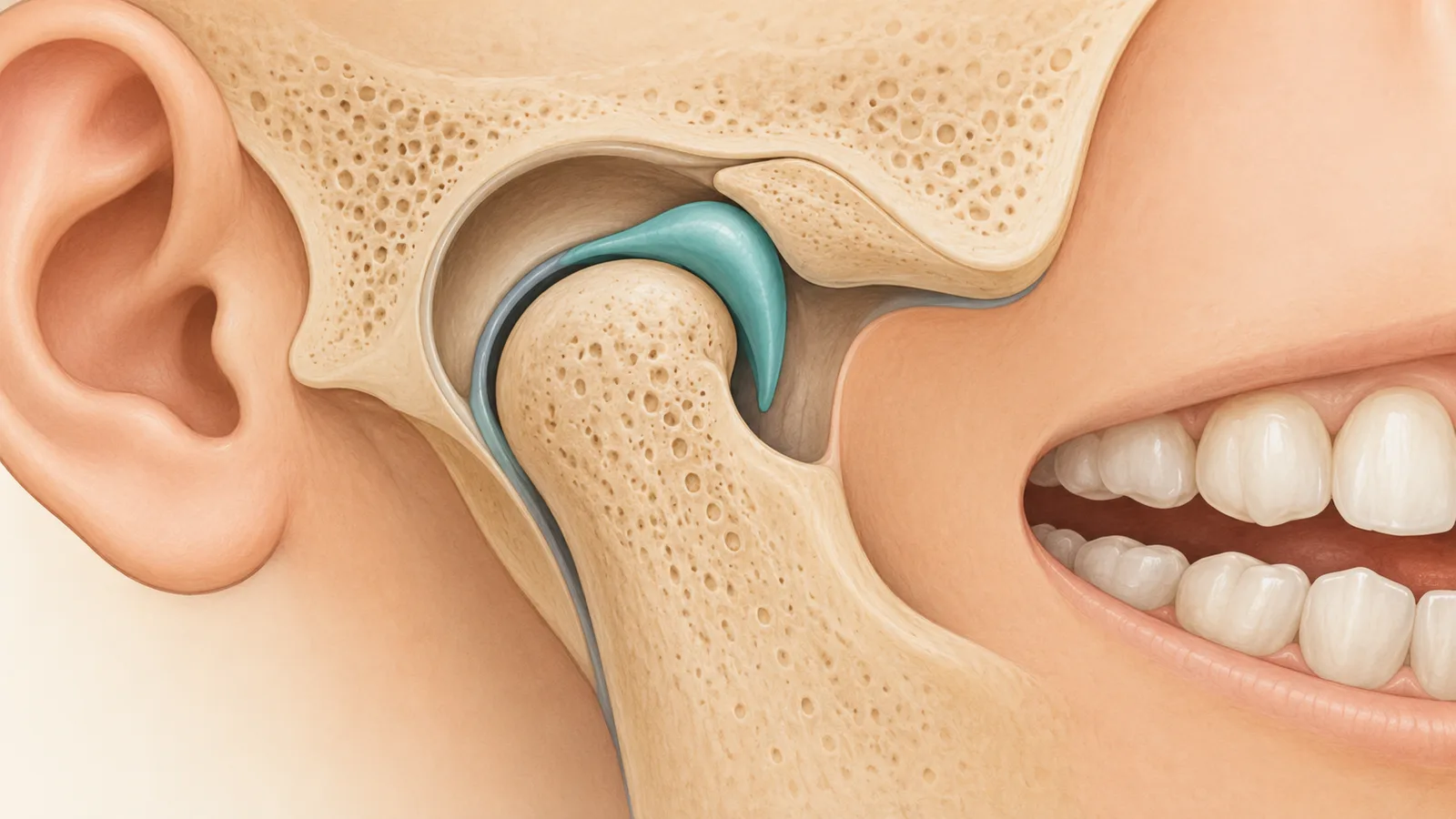
Orofacial Pain Specialist or Oral & Maxillofacial Surgeon: Who Should Treat My TMJ?
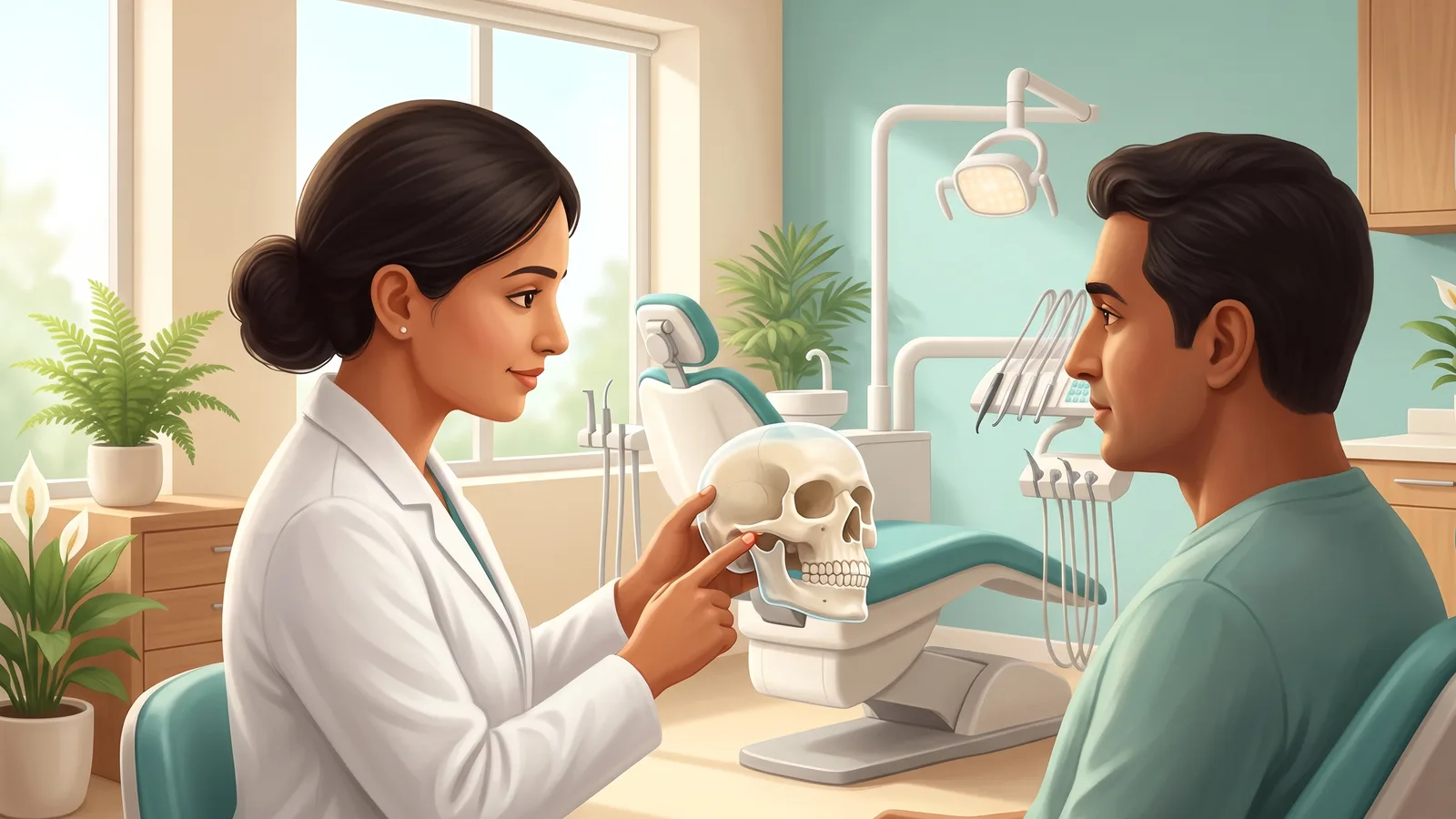
Both can treat TMJ problems. The best choice depends on your symptoms and on whether your jaw joint may need a procedure later. An orofacial pain specialist focuses on pain in the jaw, face and head. An oral and maxillofacial surgeon treats the jaw joints across the whole range: most TMJ problems without surgery, and joint procedures when a diagnosis requires them. Whoever you see, simple and reversible care should come first (NIDCR).
Key points
- TMJ disorders (TMD) affect the jaw joints, the chewing muscles or both. Many improve without treatment or with simple care (NIDCR).
- The main difference: a surgeon can also treat the joint itself if a procedure is ever needed.
- A click without pain usually needs no treatment (NIDCR).
- Ask any specialist what they will try first, and what would make a procedure necessary.
Who treats TMJ disorders?
Several kinds of clinician can help, and they often work together:
- A dentist with TMJ experience can examine the jaw, check the teeth and bite, and start simple care.
- An orofacial pain specialist is a dentist with further training in jaw, face and head pain, including muscle pain and nerve-related facial pain.
- An oral and maxillofacial surgeon is a dental specialist trained in the jaw joints, jaws and face. TMJ care is part of this specialty.
- A physiotherapist can advise on jaw exercises and massage (NHS).
- A medical doctor is needed when the pain may come from somewhere else. A severe headache with scalp tenderness or vision problems needs urgent medical assessment (NHS).
What does an orofacial pain specialist do?
The American Academy of Orofacial Pain describes orofacial pain as the dental specialty that covers the diagnosis, management and treatment of pain disorders of the jaw, mouth, face, head and neck. In the United States, the American Dental Association recognised it as a specialty in 2020. These clinicians are especially useful when pain is the main problem, when it has lasted a long time, or when it may come from the muscles or nerves rather than the joint.
What does an oral and maxillofacial surgeon do for TMJ?
The surgeon first works out whether the problem is in the joint, the chewing muscles or both, and checks for other causes, such as a tooth problem. Most TMJ care is non-surgical. NIDCR recommends conservative, reversible treatment first. It advises avoiding treatments that permanently change the joint, teeth or bite, or that involve surgery, when simpler care is available (NIDCR).
What the surgeon adds is the ability to treat the joint itself when that is truly needed. NIDCR describes joint washout (arthrocentesis) and arthroscopy for selected joint problems. It keeps open surgery for joint damage that other procedures cannot fix, or for severe symptoms that have not responded (NIDCR). Guy's and St Thomas' notes that these procedures are for joint and disc problems, not jaw-muscle pain, and that they are not always successful (Guy's and St Thomas' NHS Foundation Trust).
Which specialist suits your situation?
| What you notice | Who can help | Points to know |
|---|---|---|
| Jaw clicks but does not hurt | Usually no treatment needed | A pain-free click is common and normal |
| Sore jaw muscles, clenching or grinding | Either specialist, plus physiotherapy | Start with simple, reversible care |
| Painful clicking or the jaw catching | Either; a surgeon can also assess the joint | The examination decides joint or muscle |
| Jaw locks or will not open fully | Urgent assessment; a surgeon if the joint is the cause | A jaw stuck open needs emergency care |
| Joint damage, a jaw injury, or no improvement | Oral and maxillofacial surgeon | Procedures are only for selected cases |
| Burning or electric-shock facial pain | Orofacial pain specialist or a medical doctor | It may not be a TMJ problem |
Sources: (NIDCR; NHS; Guy's and St Thomas' NHS Foundation Trust).
Why one specialist for the whole pathway can help
TMJ care often happens in steps: assessment, self-care, therapy and, for only a few people, a joint procedure. When one specialist manages every step, your history and scans stay in one place. The same person explains each decision. And if a procedure is ever needed, there is no new referral. This is a practical advantage, not a reason to have a procedure: simple care should still come first (NIDCR).
What should you ask any TMJ specialist?
- What is causing my pain or clicking: the joint, the muscles, or both?
- What will we try first, and when will we review it?
- Do I need a scan, and what question would it answer?
- If you suggest a splint, what is it for, and how will we know it is helping?
- What would make a joint procedure necessary, and who would carry it out?
A good answer explains the diagnosis, starts with reversible care and is clear about when, if ever, a procedure would be considered. Be cautious about any plan that starts by grinding down teeth, permanently changing your bite or going straight to injections such as Botox (NIDCR).
When is it urgent?
Seek urgent help if you cannot eat or drink, or if your jaw locks or will not open fully. The same applies to frequent severe headaches, pain or tenderness at the side of the head or scalp, or vision problems such as double vision (NHS). These can have causes outside the jaw.
For a jaw that clicks without pain, see jaw clicks without pain. For what simple care involves, see whether TMJ pain can improve without surgery. For a jaw that locks, see what to do about a locked jaw.
Where can I see a TMJ specialist in Gurgaon?
Dr. Supreet Kaur Sawhney is an MDS-qualified oral and maxillofacial surgeon and TMJ specialist in Gurgaon, with more than 20 years of experience. She starts with assessment and non-surgical care, including jaw physiotherapy and splints when suitable. Dr. Jaydeep Singh Rajpoot (BPT, MSPT), a physiotherapist at Active Align Clinic, works at the same Sector 39 premises. Jaw physiotherapy can be arranged there on site. When a diagnosis requires it, she performs TMJ arthroscopy and open joint surgery herself. She sees patients at Dr. Supreet's Dental & Implant Centre in Sector 39, Gurugram. Read about TMJ treatment in Gurgaon or non-surgical TMJ treatment, contact the clinic, or call or WhatsApp +91 9650298009.