All-on-6 Dental Implant Assessment in Gurugram
A six-implant proposal should explain what the additional supports allow in your particular jaw. Their positions and the replacement design matter alongside the count: extra implants may make separate sections of fixed teeth possible or provide a contingency if one implant fails, depending on the case. In Gurugram, Dr. Supreet Kaur Sawhney offers implant and full-arch assessment to help you understand that reasoning before choosing treatment.
A consultation that connects support with the final teeth
Dr. Supreet is an MDS, Senior Consultant – Oral & Maxillofacial Surgeon and Senior Implantologist with 20+ years of experience. When you bring a six-implant proposal, her consultation can connect its surgical requirements with the teeth it is intended to support, your remaining natural teeth and ongoing maintenance. The aim is an understandable plan with alternatives, rather than a decision based on implant count alone.
Appointments can be requested at Dr. Supreet's Dental & Implant Centre, Sector 39, Gurugram. This page explains six-support planning for discussion; an assessment determines the appropriate approach for your mouth.
What does All-on-6 describe?
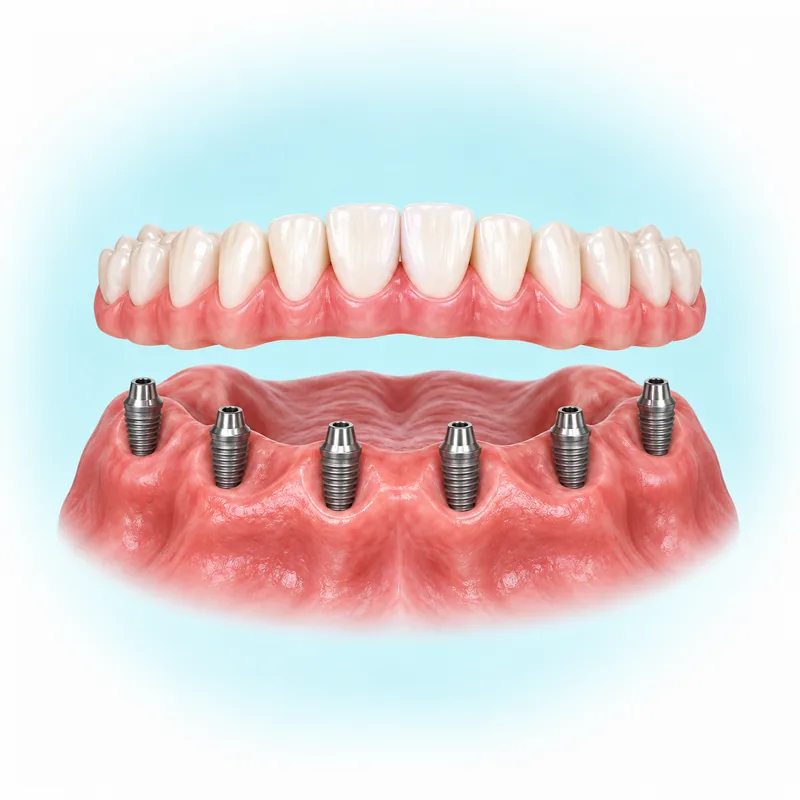
In the clinical trial discussed here, the All-on-6 protocol used six implants to support one fixed replacement spanning the upper jaw. The trial definition does not mean that all plans carrying the name share the same positions, loading timetable or final restoration. It describes whole-jaw support, not six individual replacement teeth.
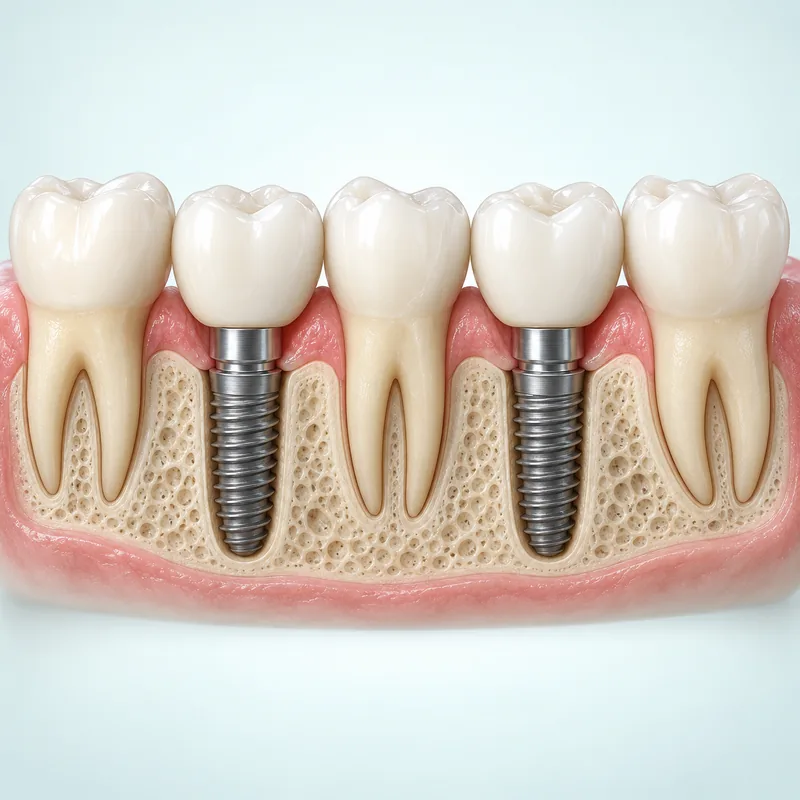
The 2018 International Team for Implantology (ITI) consensus recommends at least four suitably distributed implants for a one-piece fixed complete-arch restoration. Additional implants may allow the teeth to be made in separate sections or offer a contingency after an implant failure. Those possibilities depend on the case; six implants do not guarantee that a failed implant can be ignored or that the original restoration will remain usable.
The extra sites must fit the planned restoration
The decision includes available bone shape, room for the replacement teeth, lip support, how much tooth and gum show when smiling, and the teeth in the opposite jaw. The unsupported extension beyond the last implant, called a cantilever, and access for cleaning also influence the design. Six poorly suited positions do not become an appropriate plan merely because the count is higher.
Before agreeing to remove remaining teeth, their potential for preservation should be considered. The full-mouth rehabilitation guide explains the wider decision about retaining teeth and coordinating replacements; a full-arch proposal is one possible part of that assessment.
Planning may use X-rays and impressions, which record the shape of the mouth, selected for the question being answered. General health, medical conditions and medicines also affect suitability and healing. If bone is insufficient for the proposed implant support, bone building may be needed; it is not necessary for everyone.
Does having six implants improve survival compared with four?
A higher count alone does not establish a better outcome. The ITI evidence review found no statistically significant implant-survival difference between groups with fewer than five implants and groups with five or more. These grouped counts covered different configurations; they are not proof that exactly four and exactly six are interchangeable.
The direct comparison was a trial of 40 selected patients receiving immediately loaded fixed upper-jaw teeth. At five years it found no statistically significant difference in implant failure between the four- and six-implant groups. That means the study did not detect a difference, not that it proved equivalence. Both groups had tissue-related and restoration-related complications. This small upper-jaw trial does not supply a personal survival prediction or settle every lower-jaw decision.
The four-implant assessment guide explores four-support distribution, possible tilted back implants and provisional teeth. Comparing the actual proposed designs is more useful than treating either number as a universal winner.
Six supports do not settle when teeth can be fitted
Implant placement timing and loading timing are separate decisions. Immediate loading means teeth are connected in bite contact within one week of implant placement; fitting a restoration kept out of bite contact is a different category. These definitions do not promise a personal schedule.
For fixed whole-jaw teeth, the intended restoration should be planned before placement. Immediate loading needs adequate initial stability of the supporting implants, meaning how firmly they are held in the bone when placed. Bone building at the same operation may make it less suitable: ITI guidance considers this a relative concern, not an absolute prohibition. A fallback plan is needed if surgical findings prevent the intended immediate approach.
In the selected upper-jaw trial, patients first received provisional, or temporary, teeth and later a definitive restoration—the intended final replacement. Six implants did not make the initial teeth automatically final. Your sequence follows the assessment and findings rather than that trial's timetable.
Care involves the tissues and the replacement teeth
Implant surgery carries risks including injury to nearby teeth, nerves or other structures, with the risk depending on the sites and procedure. Infection or failure to join the bone can result in implant loss. Smoking can impair healing and longer-term outcomes. The additional supports do not remove these risks.
Soreness, swelling, bruising and minor bleeding may follow surgery; recovery varies. Use the surgical team's instructions for cleaning the operated area at each healing stage. Continuing daily cleaning and professional reviews remain necessary, and cleaning access should be built into the fixed restoration plan.
Pain or a feeling that an implant is loose needs prompt dental assessment. Contact the treating team if swelling, discomfort or another problem worsens in the days after surgery. Bleeding that remains uncontrolled requires urgent local emergency care; this differs from a small amount of initial oozing.
Bring your six-implant proposal to an assessment in Gurgaon
Bring existing records and the proposed restoration design to Dr. Supreet's Dental & Implant Centre, 395 P, Sector 39, Near Medanta Hospital, Gurugram, Haryana 122001. Discuss the reason for the extra supports, bone requirements, what happens if early loading is unsuitable and the maintenance plan. Treatment stages and the estimate depend on the agreed individual plan.
Read the broader dental implant guide, request an appointment or call +91 9650298009.