Laser-Assisted Periodontal Treatment in Gurugram
Start with the gum-disease diagnosis
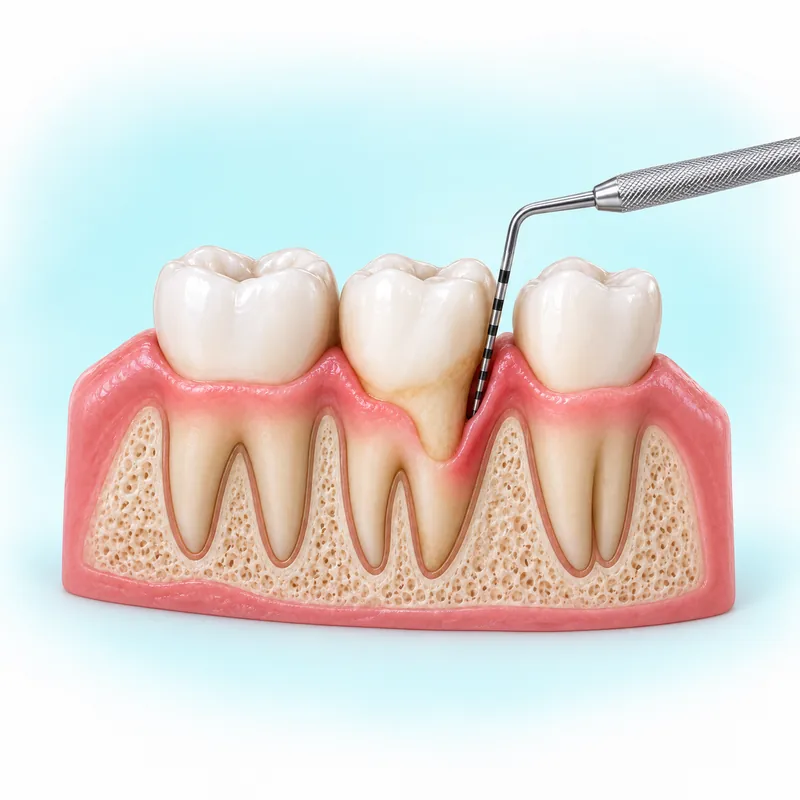
Dr. Supreet Kaur Sawhney in Gurugram discusses the gum-disease diagnosis and intended treatment before a periodontal laser is considered. Periodontitis damages the attachment and bone supporting teeth. Assessment includes loss of support, gum-pocket depth (spaces between gum and tooth), bleeding and bone changes on dental images. The clinician interprets these findings; a laser label alone does not define the operation.
Sources (2)
Use the gum surgery and grafting guide to discuss where a proposed laser procedure fits within your broader gum-treatment plan.
Initial care for stages I–III
Stages I–III are clinical categories describing periodontitis severity. The guideline pathway first addresses plaque—the soft bacterial buildup on teeth—and risk factors, then professional cleaning below the gum where indicated. Stopping smoking and improving diabetes control, when relevant, support this care but do not replace periodontal treatment. A laser should not be presented as a substitute for these steps.
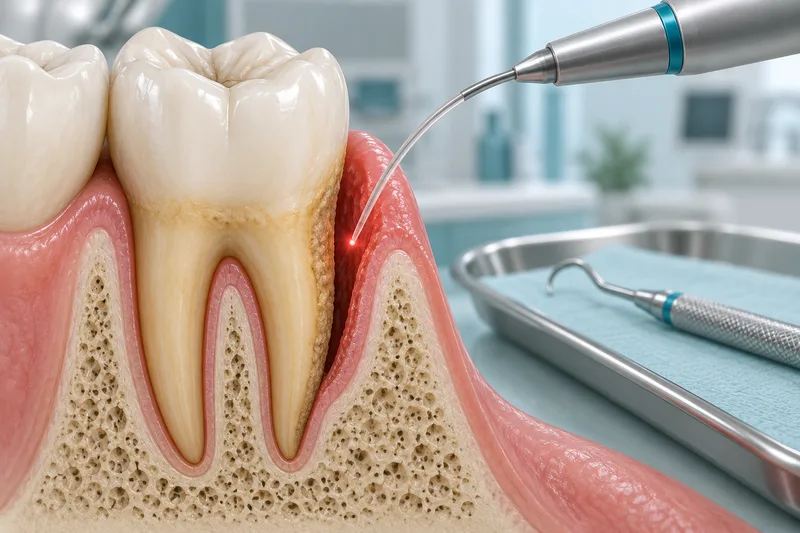
Does adding a laser improve gum-disease treatment?
The European Federation of Periodontology (EFP) suggests against adding the studied lasers as an adjunct to below-gum cleaning for stage I–III periodontitis. Here, adjunct means an added treatment alongside the cleaning. The recommendation is based on five trials using specific laser wavelengths and six-month outcomes. It concerns those added uses; it does not prohibit every laser soft-tissue operation or establish which alternative laser is better.
The proposed laser visit and its limits
In one described periodontal pathway, a small laser is used beneath the gums to treat diseased tissue; the choice depends on disease stage and health. Numbing, incision or stitch needs and recovery must be explained for the actual operation, rather than assumed to be the same for all devices. Controlled comparisons do not establish universal laser superiority or equivalence over scaling and root planing alone. An inappropriate laser wavelength or power can damage periodontal tissues; this is a technique warning, not an individual complication prediction.
Sources (2)
Cleaning and review after treatment
Cleaning, medicine instructions and recovery depend on the procedure. Ongoing oral hygiene and regular dental review help maintain the result. Daily brushing and cleaning between teeth help control plaque and recurrence; use the technique and any operated-site adjustments advised by the treating team. Do not transfer a recovery estimate from below-gum cleaning or advanced surgery to a different laser route.
Sources (2)
When to contact the treating team
After periodontal treatment, contact the team for bleeding that will not stop, severe or persistent pain, pain that worsens after several days, fever or pus at the treatment site. These are general post-periodontal-treatment warnings, not laser-specific complication rates.
Sources
Arrange an assessment
Dr. Supreet Kaur Sawhney, MDS, is a Senior Consultant Oral & Maxillofacial Surgeon and Senior Implantologist with more than 20 years of experience. Dr. Supreet’s Dental & Implant Centre is at 395 P, Sector 39, near Medanta Hospital, Gurugram (Gurgaon), Haryana 122001. For an assessment, contact the clinic or call +91 9650298009.