Occlusal Adjustment for Stage IV Periodontal Care in Gurugram
Limited reshaping of tooth contacts is irreversible. It may be considered within periodontal therapy for someone with all teeth present, stage IV periodontitis (complex advanced gum disease), very loose teeth from loss of supporting tissue and associated difficulty with tooth contacts; this conditional recommendation rests on very uncertain evidence. Dr. Supreet Kaur Sawhney, MDS in Oral & Maxillofacial Surgery, is a Senior Consultant and Senior Implantologist with 20+ years of experience.
What selective occlusal adjustment changes
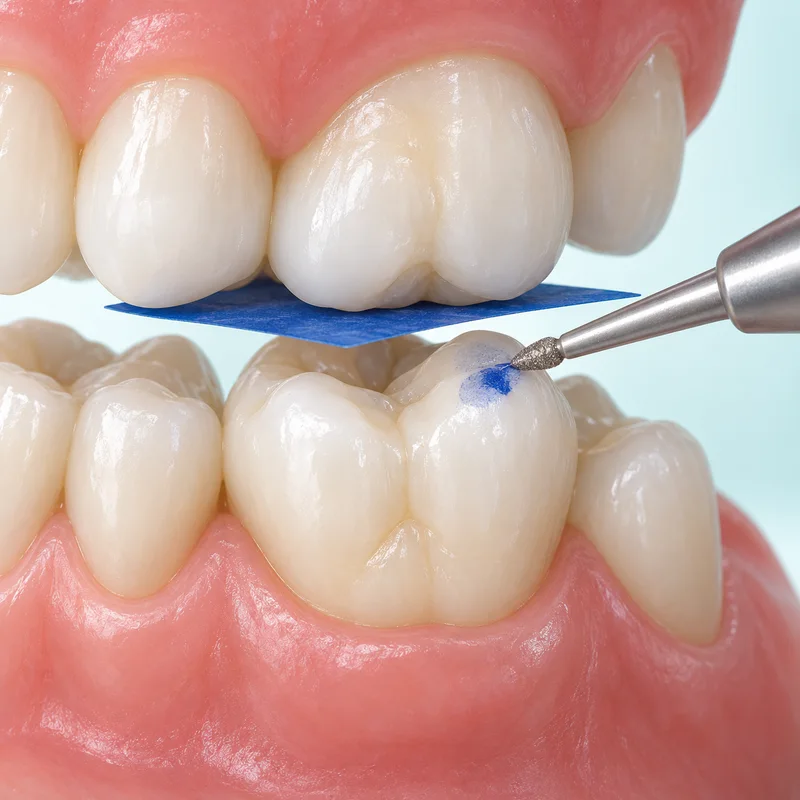
Occlusal adjustment is reshaping selected biting surfaces to modify contacts between teeth. It is irreversible because tooth structure removed cannot be restored by undoing the adjustment.
Sources (2)
The guideline context is narrow: a clinician may consider limited selective adjustment as part of periodontal treatment when a fully dentate person (all teeth present) has stage IV periodontitis (complex advanced gum disease), hypermobile (very loose) teeth from advanced loss of tooth-supporting tissue and associated problems with tooth contacts. It is not a general treatment for a high spot or jaw pain.
Expected benefits and limits
The recommendation is conditional and based on very-low-certainty evidence. The effect on tooth loss is unclear, and patient-reported outcomes and adverse effects are limited; an individual benefit or tooth-retention result cannot be promised.
Intentionally grinding down teeth or changing the bite is not an established treatment for temporomandibular disorders (jaw-joint or chewing-muscle disorders) and may worsen symptoms. The periodontal indication should not be transferred to jaw-joint complaints.
Gum care and reassessment
After active treatment for stage IV periodontitis, supportive periodontal care (ongoing gum-disease maintenance) checks gum health, risk factors, home cleaning and whether more treatment is needed. The schedule is personalized; adjustment itself does not replace gum maintenance.
If a tooth stays loose or becomes looser after periodontal treatment, it needs reassessment. After successful treatment of stage IV periodontitis, a clinician may consider a long-term periodontal splint (joining loose teeth) for comfort when looseness persists or increases. Evidence for this option is very uncertain; it is not proof that adjustment failed and does not promise to cure looseness.
Read the wider gum-care and gum-surgery guide, and compare periodontal splinting for loose teeth when support for comfort is being discussed. These options address different findings.
Discuss Occlusal Adjustment for Stage IV Periodontal Care in Gurugram
Dr. Supreet’s consultation can help review findings, alternatives and next steps. Dr. Supreet’s Dental & Implant Centre is at 395 P, Sector 39, near Medanta Hospital, Gurugram (Gurgaon), Haryana 122001. Bring prior records and a current medicine list. View the Sector 39 clinic, contact the clinic or call +91 9650298009 to ask about an appointment.